

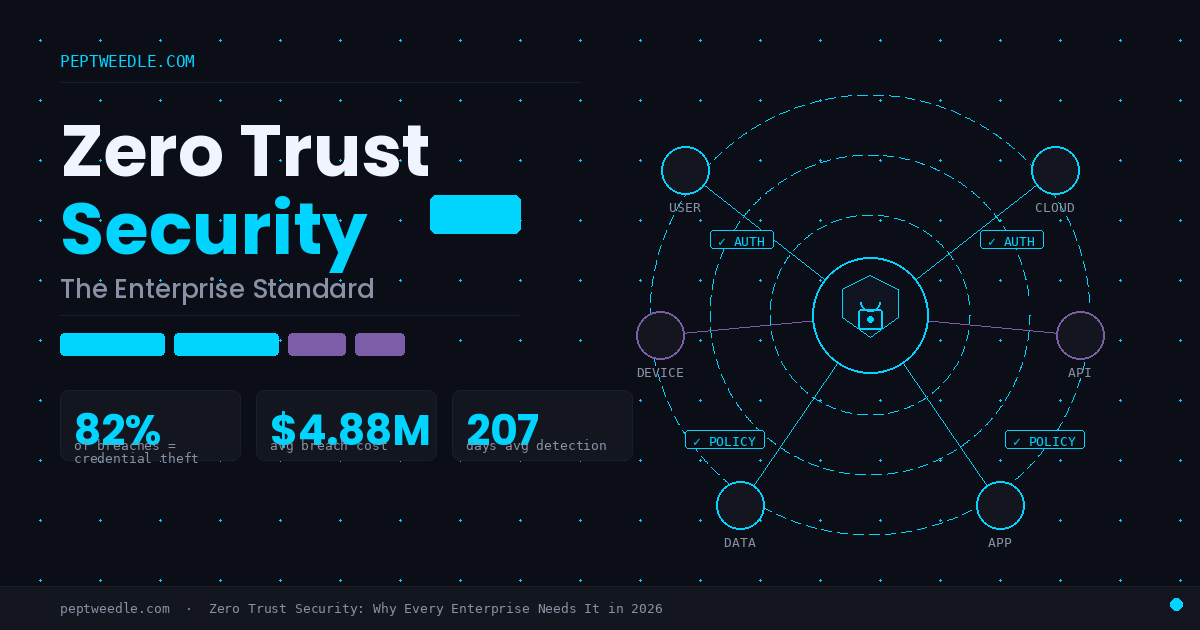
Zero Trust Security: The 2026 Enterprise Standard
Let's be honest — most enterprise security in the 2010s was built on a fairly shaky assumption: that everyone inside the network perimeter was trustworthy, and everything outside was the enemy. You built a big wall, put a moat around it, and assumed whatever made it past the firewall was safe.
That model is completely broken now. Remote work scattered your users across coffee shops, home offices, and airport lounges. Cloud workloads moved your data outside any perimeter you could reasonably defend. And attackers got smarter — they don't knock on the front door; they steal credentials, blend in, and move laterally for months before you even notice.
Zero trust isn't a product you buy. It's a philosophy — and in 2026, it's the baseline, not a differentiator. Here's what it actually means, why it matters, and how to get there without turning your org into a bureaucratic nightmare.
The Death of Perimeter Security
The traditional perimeter model made sense when everyone worked from a single office, accessed on-premise servers, and used company-issued hardware sitting inside a corporate LAN. That world doesn't exist anymore.
Think about the modern enterprise attack surface: contractors logging in from personal laptops, SaaS apps living entirely outside your data centre, microservices talking to each other across multi-cloud environments, IoT devices running on factory floors with default credentials. The perimeter isn't just leaky — it's conceptually irrelevant.
The SolarWinds attack in 2020 is still the textbook example. Attackers compromised a trusted software update, got inside thousands of "secure" networks, and moved laterally for months. The perimeter was intact. The network was fully breached. If those organisations had been enforcing least-privilege access and continuous verification, the blast radius would have been dramatically smaller.
The Colonial Pipeline ransomware attack followed a similar playbook — an old VPN account with no MFA. One set of credentials. A pipeline shut down. Fuel shortages across the US East Coast.
Core Zero Trust Principles
Zero trust is built on three foundational ideas, popularised by John Kindervag at Forrester around 2010 and refined extensively since. They're simple to state, hard to implement, but worth understanding deeply before you buy a single product.
Always authenticate and authorise based on every available signal — identity, location, device health, service or workload, data classification, and anomalies. Never rely on network location alone.
Limit user access with just-in-time and just-enough-access. Minimise lateral movement risk. Don't give a developer access to prod databases just because it's convenient.
Design as if attackers are already inside. Minimise blast radius, segment access, encrypt everything, and use analytics to detect threats and improve defences.
Authentication isn't a one-time event at login. Re-verify continuously based on risk signals — anomalous behaviour, unusual locations, device posture changes.
In technical terms, this maps to a few key architectural shifts. You move away from network-based trust (IP address = trusted) to identity-based trust (verified identity + device + context = access decision). Every request — whether it's a user accessing an app or a microservice calling an API — goes through a policy engine that makes a real-time access decision.
The NIST Special Publication 800-207 is the canonical reference document if you want the full architectural blueprint. It defines zero trust as a set of guiding principles rather than a specific technology, which is important — vendors love slapping "zero trust" on products that don't actually implement the philosophy.
5-Step Implementation Roadmap
Zero trust is a journey, not a rip-and-replace project. Most mature enterprise implementations take 3–5 years. The goal isn't to do it all at once — it's to start moving in the right direction and build momentum.
Unlike the attack surface (which is infinite), the protect surface is small and definable. It includes your most critical data (PII, IP, financial records), applications (ERP, CRM, core SaaS), assets (servers, endpoints, IoT devices), and services (APIs, authentication infrastructure). Document these before you do anything else. You can't protect what you haven't catalogued.
Understand how data moves in your environment. Which users access which systems? Which services talk to which APIs? What does normal look like? This is often the most uncomfortable step — many orgs discover shadow IT, forgotten service accounts with excessive permissions, and undocumented data flows they had no idea existed.
Implement a policy enforcement point (PEP) and a policy decision point (PDP) — ideally through a modern Identity Provider (IdP) combined with a next-gen firewall or SASE platform. Micro-segmentation is your friend here. Instead of one flat network, carve it into small, isolated segments so compromising one doesn't mean compromising everything.
Define granular access policies using the "who, what, when, where, why, and how" framework. Who is this user? What device are they on? When is this access happening? Why do they need it? Enforce MFA universally — passwordless where possible. Implement conditional access policies in your IdP that adapt in real time based on risk signals.
Zero trust requires continuous telemetry. Instrument everything — network flows, login events, API calls, privilege escalations. Feed this into a SIEM or XDR platform and use it to tune policies, detect anomalies, and prove compliance. Zero trust is never "done" — it evolves as your environment and threat landscape change.
Top Tools for 2026
The zero trust vendor landscape is crowded and jargon-heavy. Here's a clear-eyed look at the key categories and the tools that enterprise teams are actually deploying in 2026.
| Tool / Platform | Category | What it actually does |
|---|---|---|
| Okta / Microsoft Entra ID | IAM / IdP | Identity foundation. Handles authentication, MFA, SSO, and conditional access policies. Your first zero trust investment. |
| Zscaler Private Access | ZTNA | Replaces VPN with application-level access. Users connect to apps, not networks. Strong SASE play for distributed workforces. |
| Cloudflare Access | ZTNA | Developer-friendly ZTNA with excellent performance globally. Often a strong choice for tech-forward orgs already on Cloudflare's network. |
| CrowdStrike Falcon | EDR / XDR | Endpoint detection, device posture assessment, and threat intelligence. Critical for the device verification pillar of zero trust. |
| HashiCorp Vault | Secrets Mgmt | Zero trust for machine identities. Manages secrets, certificates, and encryption keys across cloud and on-prem — prevents hardcoded credential disasters. |
| Palo Alto Prisma Access | SASE | Full SASE platform combining ZTNA, SWG, CASB, and FWaaS. Enterprise-grade but heavyweight — sized for large orgs. |
| Wiz / Orca Security | CNAPP | Cloud-native application protection. Finds misconfigurations, excess permissions, and exposed credentials in cloud environments before attackers do. |
A word on SASE — Secure Access Service Edge — which has become the convergence point for networking and security in 2026. SASE combines SD-WAN, ZTNA, secure web gateway, CASB, and firewall-as-a-service into a cloud-delivered architecture. For enterprises replacing legacy MPLS networks and on-prem firewalls, a SASE platform can dramatically simplify the zero trust stack.
Common Adoption Mistakes
Zero trust implementations fail more often from bad execution than bad technology. Here are the patterns that trip up even well-resourced enterprise security teams.
No vendor sells you zero trust in a box. Orgs that buy one tool and call it "zero trust" end up with a false sense of security and a big invoice. The framework spans identity, devices, networks, applications, and data — it requires coordinated effort across all of them.
Micro-segmentation is powerful, but it means nothing if your identity layer is weak. If attackers can steal credentials and authenticate successfully, all the segmentation in the world won't save you. Identity is the new perimeter — start there.
Perfect is the enemy of shipped. Teams that spend months designing the ideal policy framework before enforcing anything end up with a theoretical security model that has zero real-world coverage. Start with broad policies, then tighten iteratively based on actual usage patterns.
Most zero trust conversations focus on human users. But in modern cloud environments, machine-to-machine calls often outnumber human sessions by 100:1. Hardcoded API keys, long-lived service account tokens, and over-privileged IAM roles are a massive blind spot. Workload identity needs the same rigour as human identity.
Zero trust touches every team — dev, ops, HR, legal, procurement. Without executive sponsorship and cross-functional alignment, you'll hit resistance at every turn. Security teams trying to enforce least privilege on developer workflows without leadership backing end up in an unwinnable political battle.
Frequently Asked Questions
Where's Your Organisation on the Zero Trust Journey?
Zero trust looks different at every company — different stacks, different risks, different starting points. Is your organisation just getting started, mid-implementation, or further along? Share your experience, the tools you're using, and the mistakes you've learned from. The more practitioners talk openly about this, the better the industry gets.
 1
1
Post Your Comment